Share Blog Post
Email
Facebook
Reddit
LinkedIn

What is SIP UA? How can thin devices benefit from a cloud-based SIP User Agent?

Table of Contents
What is SIP UA? How can thin devices benefit from a cloud-based SIP User Agent?

In Voice over IP (VoIP) and real-time communications, Session Initiation Protocol (SIP) is a critical standard. At the heart of SIP-based communication lies the SIP User Agent (UA), a key component responsible for handling call signaling and media negotiation. But what happens when a device lacks the resources to support a full SIP stack? Enter the concept of thin devices—and the innovative solution of cloud-based SIP UAs.

In this blog post, we’ll break down what SIP UA is, how it works, and how a cloud-based SIP UA can empower resource-constrained or legacy devices to engage in modern VoIP communication in an easy way.

What is SIP UA?

SIP UA is a logical entity within a SIP network that can initiate, manage, and terminate SIP sessions. It can act in two roles:

  • User Agent Client (UAC) – initiates SIP requests and handles responses
  • User Agent Server (UAS) – receives SIP requests and responds to those requests

In most applications, a single device (like a softphone or IP phone) acts as both a UAC and UAS, allowing it to initiate and receive calls. SIP UAs are responsible for handling call setup (e.g., ringing, answering), registration with SIP servers, codec negotiation, and session teardown.

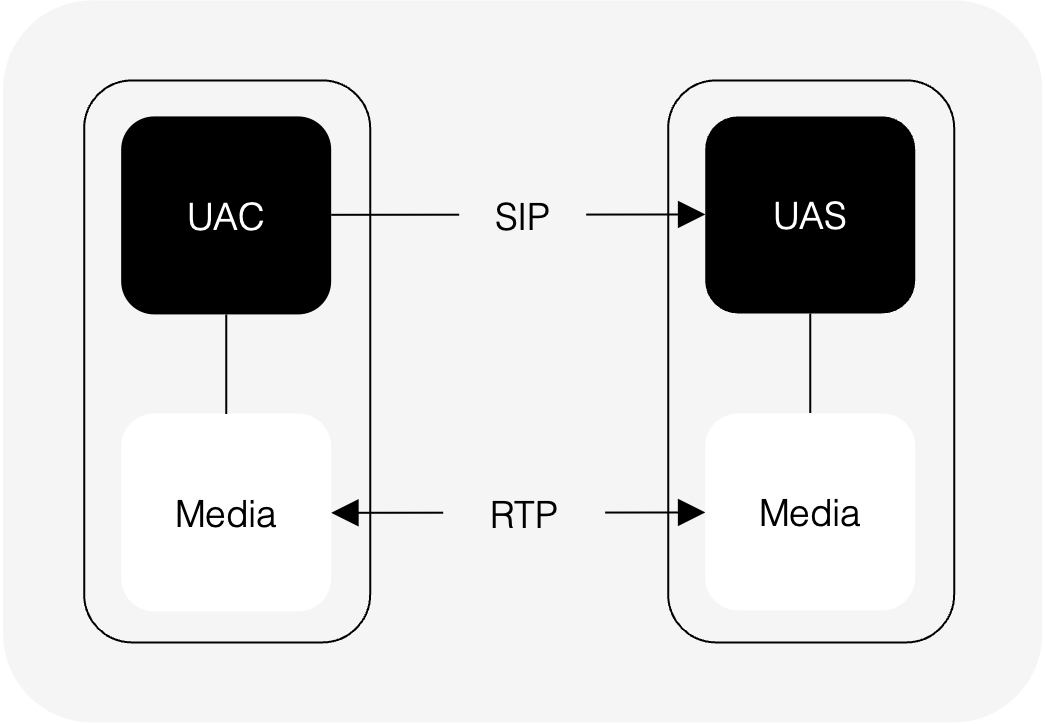
Next to the SIP UA is the media handling function. The media handling function is responsible for capturing audio from a microphone, encode this into an RTP stream, and send it to the remote party. In the opposite direction it’s responsible for receiving RTP streams to be decoded and played out in the speaker.

What is SIP UA - iotcomms.io Cloud SIP UA Service
User Agent Client (UAC) and User Agent Server (UAS) in a SIP network.

What are thin devices?

Thin devices are hardware endpoints that lack memory and/or CPU resources to host a full SIP stack. These devices may be capable of capturing or playing audio, but they don’t have the software architecture to manage SIP protocols directly. Examples include:

  • IoT sensors: Devices that collect and transmit data but are not equipped for complex communication protocols
  • Social care devices: Compact devices designed for emergency communication
  • Intercom panels: Compact devices designed for communication within a building, home, or office
  • Smart watches: Compact devices designed with low power requirement

Cloud-based SIP UAs

To enable thin devices to participate in SIP communications, SIP UA functionality can be hosted as a service in the cloud. These services act as intermediaries, handling SIP signaling and media management on behalf of the device.

The device communicates with the cloud service using REST API and callbacks, while the cloud service manages the complex SIP interactions. This way the footprint of the devices is reduced to only handle media.

iotcomms.io’s Cloud SIP UA Service

iotcomms.io’s Cloud SIP UA Service is a cloud-native SaaS service that brings SIP communication capabilities to your thin devices in an easy and efficient way using REST APIs.

The Cloud SIP UA Service integrates natively with all iotcomms.io’s services, making it straightforward to build scalable, end-to-end communication solutions.

Through the iotcomms.io SIP Core Service, all functions required for devices to participate in VoIP communication, across both private networks and public infrastructures, are provided. The iotcomms.io SIP Mediaserver Service, which supports advanced communication scenarios, makes it easy to add Interactive Voice Response (IVR) flows, media playback, and real-time media processing to your solution, without you needing to manage the complexity of the telephony stack yourself.

How the Cloud SIP UA Service works

The Cloud SIP UA Service enables thin devices to connect with SIP-based communication systems through REST APIs and real-time callbacks mirroring SIP signaling. The devices interact with the service using these APIs to initiate, manage, and terminate calls. The API calls are translated into SIP messages, enabling communication with remote SIP endpoints.

Real-time callbacks notify the device of important SIP signaling events, such as incoming calls or call progress updates. Meanwhile, RTP media streams are routed directly to and from the device based on the signaling instructions. This architecture ensures efficient and scalable real-time communication with the complexity of the SIP protocol handled entirely by iotcomms.io.

See below sequence diagram for placing a call. More information is provided in the Cloud SIP UA Service Getting Started documentation.

iotcomms.io cloud sip ua service sequence diagram
iotcomms.io's Cloud SIP UA Service - place a call sequence diagram

Enhance thin devices and let iotcomms.io handle the telecom complexity

iotcomms.io’s Cloud SIP UA Service enhances the capabilities of thin devices and handles all the required signaling. For devices located behind at NAT, the SIP Core Service provides media relay capabilities for use cases requiring NAT Traversal. The SIP Core Service also provides functions to convert between encrypted SRTP streams and unencrypted RTP streams as well as transcoding functionality.

Combined with the SIP Core Service, the Cloud SIP UA Service comprises an ideal offering for solution providers looking to VoIP-enable their devices’ communication, without the overhead of implementing full SIP stacks.

With iotcomms.io taking care of all underlying telecom complexity in its SaaS delivery model, it brings a cost-and operations effective way to modernize and enhance thin devices’ communication capabilities.

Want to enable SIP-based communication for thin devices? Contact us here