Voice activated assistants, also known as smart speakers and typically built by global providers such as Amazon and Google, come with their own API. This means that every new deployment requires individual integration for each alarm receiving centers (ARC) it connects to. That is a pretty significant undertaking!
Can smart API-based cloud services and protocol conversion capabilities help solve the integration tasks natively following these deployments?
Read this blog to find out!
Smart speaker market is growing
The global smart speaker market continues to accelerate, projected to grow at over 20% CAGR through 2030 (source: GrandViewResearch). Voice-activated assistants such as Amazon Alexa, Google Assistant, and others are becoming central to connected living — not just in homes, but also in healthcare, telecare, and smart buildings.
These devices enable users to communicate in real time with control- or alarm receiving centers (ARCs), in scenarios like security, hospitality, and more.
However, as adoption rises, so do the integration demands. Each deployment introduces new requirements for compatibility, reliability, and interoperability across diverse ARC platforms.
Each deployment is an integration project
With each smart speaker coming with its own API, each new deployment means a new integration project. Add to this that ARCs typically run on different software platforms and communication protocols. This makes integration a significant undertaking, and one can easily imagine the complexity and dignity of this kind of project.
It becomes increasingly complex at scale. A nationwide rollout of smart speakers or connected telecare devices can involve dozens of ARCs, each requiring its own communication interface. Without an integration layer, one can expect long development cycles, maintenance overhead, and costly adaptations whenever an ARC software is updated.
Alarmbridge Service simplifies Alexa integration
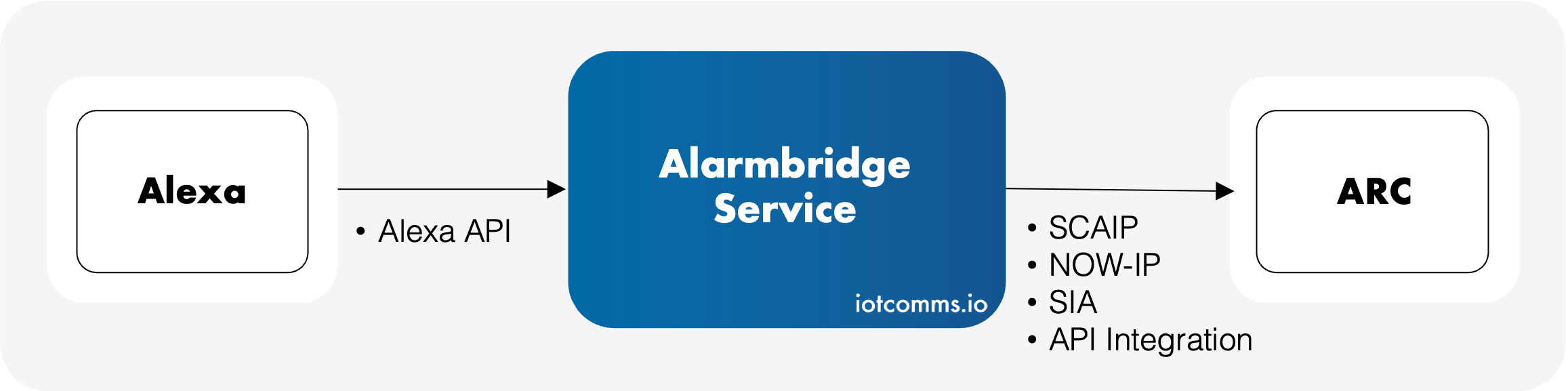
The challenges of devices and ARCs not “speaking” the same communication language is addressed with iotcomms.io’s Alarmbridge Service. Built on an event receiver and event sender architecture, it provides a flexible way to handle and convert alarm events – ensuring interoperability across diverse alarm systems and communication protocols.
With built-in support for the Alexa API, the Alarmbridge Service enables Alexa speakers to communicate seamlessly with any ARC supporting SCAIP, NOW-IP, or SIA protocols – or through direct API integration – without the need for bespoke development, see illustration below.